


Quick Answer
Solar streetlights eliminate copper wire as a theft target but introduce battery replacement cycles, weather-dependent performance, and recurring maintenance. Wired streetlights with locking hand hole covers keep infrastructure in place while using hardened security hardware to deter theft, with consistent full-brightness output every night. For retrofit projects on existing poles, wired systems with security covers are typically the faster and lower-cost path.
Solar vs Wired Streetlights: Which Actually Stops Copper Theft?
The debate over solar vs wired streetlights has moved beyond energy costs — it is now directly tied to copper theft prevention. As copper prices climbed to historic highs in early 2026, theft from streetlight poles accelerated across the country, and municipalities are increasingly weighing which system type offers the better combination of security, reliability, and long-term value.
Solar streetlights solve the theft problem by eliminating underground copper wire entirely. Wired streetlights, on the other hand, address it by securing the access point where theft occurs — using hardened locking covers on the hand hole at the base of each pole. Both approaches can be effective; however, the right choice depends heavily on your infrastructure, climate, budget, and performance requirements.
This guide breaks down how each system works, what it actually costs over 10 and 20 years, and which scenarios favor each approach — so you can make an informed decision rather than rely on simplified comparisons.
Key Takeaways
- Solar streetlights eliminate copper wire theft risk but require battery replacement every 3–10 years and routine panel maintenance
- Wired streetlights deliver consistent full-brightness output and, when paired with locking hand hole covers, provide a strong deterrent against opportunistic theft
- 20-year lifecycle costs are comparable between the two systems depending on site conditions, climate, and whether trenching is required
- For existing wired infrastructure, adding locking covers is often the most cost-effective upgrade — frequently under $300 per pole
- Solar is most advantageous in off-grid or remote locations where trenching costs would otherwise be prohibitive
In This Article
Why Copper Theft from Streetlights Is Increasing
When evaluating solar vs wired streetlights, copper theft is often the deciding factor. Copper theft has become one of the fastest-growing infrastructure problems in the United States, and rising copper prices have significantly increased incentives for theft from public infrastructure such as streetlights, traffic signals, and utility systems.
Copper theft has become one of the fastest-growing infrastructure problems affecting municipal lighting systems across the United States.
Cities evaluating solar vs wired streetlights are typically looking for the most reliable approach to streetlight copper theft prevention while maintaining consistent nighttime lighting for roads, parks, and public infrastructure.
Recent incidents show just how widespread the problem has become:
- Louisville, Kentucky: Approximately 1,400 streetlights disabled due to stolen wiring.
- Los Angeles: Cities like Los Angeles have reported tens of thousands of streetlights non-operational, with copper theft playing a role.
- Clark County, Nevada: Nearly 1 million feet of wiring stolen since 2022.
Beyond the value of stolen copper, municipalities face repair expenses, safety concerns, dark streets, delayed service restoration, and public frustration.
To address the issue, cities typically evaluate two approaches:
- Solar streetlights that eliminate copper wiring from the equation entirely
- Wired streetlights protected with locking hand hole covers that secure the wiring access point at the base of each pole
Option 1: Solar Streetlights
How Solar Streetlights Work
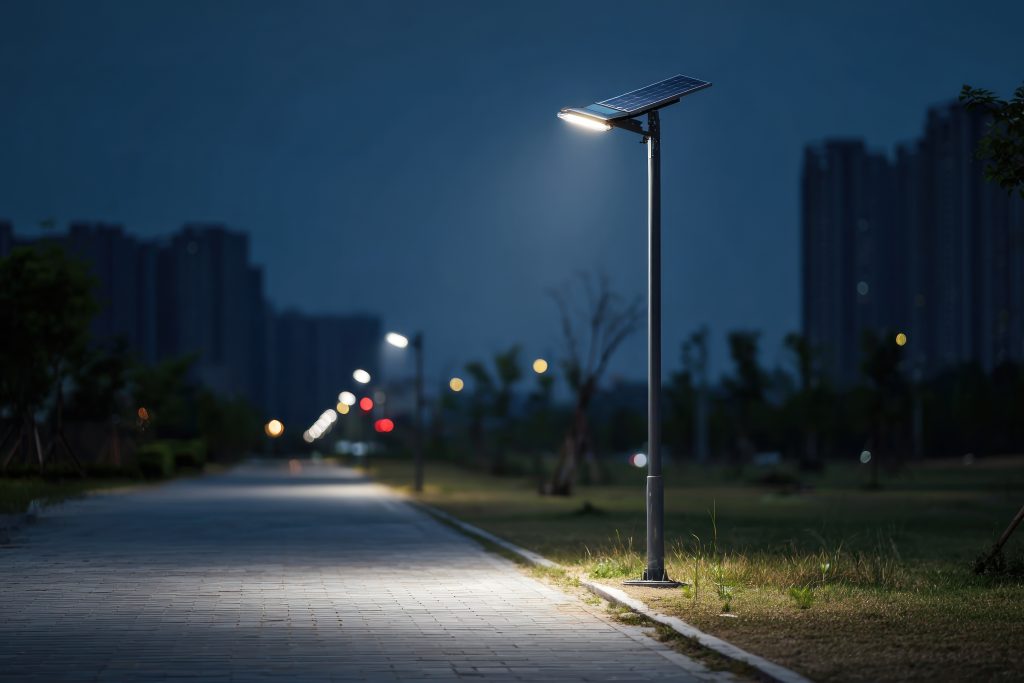
Solar streetlights operate independently from the electrical grid. A solar panel charges a battery during the day, and that stored energy powers the LED fixture at night. Because these systems do not rely on underground copper wiring, they reduce exposure to underground copper wiring as a theft target — and eliminate trenching and underground electrical installation on new builds.
Lighting Performance: Brightness and Overnight Output
Modern solar streetlights can approach the lumen output of traditional wired fixtures under favorable conditions. However, real-world performance depends on battery charge state, controller settings, weather, and recent solar gain.
In many systems, controllers reduce LED output as battery reserves decline overnight in order to preserve runtime. That is an energy-management feature, not necessarily a product failure:
- Full brightness is most likely at dusk when the battery is fully charged
- Some systems are programmed to reduce output in later hours to conserve reserve capacity
- After multiple cloudy days, batteries may start the night partially depleted
- In extended poor-weather scenarios, aging batteries can further reduce runtime and brightness
Why This Matters for Security
If your project depends on strong, consistent illumination throughout the night, brightness variability matters. Wired streetlights generally provide consistent output from dusk to dawn, while solar performance depends on charging conditions, controller strategy, and battery health.
Weather Dependence
Solar lighting performance depends directly on available sunlight.
- Cloudy weather reduces charging efficiency
- Extended storms can drain battery reserves
- Winter months provide shorter daylight hours precisely when nights are longest
As a result, solar reliability varies significantly by climate and location. What performs well in a high-sun region may not deliver the same consistency in cloudy coastal or winter-heavy environments.
Battery Replacement Costs
Every solar streetlight contains a battery that will eventually need replacement. As batteries age, both brightness and runtime can decline.
- Lead-acid batteries: typically replaced every 3–5 years
- Lithium batteries: typically replaced every 5–10 years
Consequently, across larger installations, battery replacement becomes a meaningful long-term cost category.
| Battery Type | Replacement Interval | Typical Cost Range (Varies by System Size) |
|---|---|---|
| Lead-Acid | Every 3–5 years | $150–$400 |
| Lithium | Every 5–10 years | $300–$1,000+ |
Solar Maintenance Requirements
Solar systems require periodic maintenance that is often underestimated during initial budgeting. Because solar components are mounted at height, service may require aerial access equipment depending on pole design and site conditions.
- Solar panel cleaning: Dust, debris, bird droppings, and site contamination reduce charging efficiency
- Battery replacement: A recurring lifecycle cost that may also involve access equipment and traffic-control planning
- Controller and LED servicing: Additional components can fail and add maintenance events
- Roadway access requirements: Maintenance on active road corridors may add labor and traffic-control costs
For these reasons, routine maintenance is part of the operating model for solar lighting and should be budgeted upfront rather than treated as an occasional exception.
Estimated Cost: 20 Solar Streetlights Over 10 and 20 Years
| Cost Category | 10-Year Estimate | 20-Year Estimate |
|---|---|---|
| Upfront installation (20 units @ $3,000–$$6,000+ per unit depending on system size, pole, and configuration) | $60,000–$100,000 | $60,000–$100,000 |
| Battery replacements (hardware only, based on typical replacement cycles and battery ranges) | $8,000–$17,000 | $16,000–$34,000 |
| Maintenance access + labor (depending on access requirements and frequency) | $3,000–$10,000+ | $6,000–$20,000+ |
| Panel cleaning and routine service (depending on maintenance practices and environment) | $0–$16,000 | $12,000–$32,000 |
| Component repairs (controllers, LEDs,depending on failure rates and system components) | $2,000–$5,000 | $4,000–$9,000 |
| Estimated Total | $73,000–$148,000+ | $98,000–$195,000+ |
Solar estimates do not include trenching (not required). Costs vary based on climate, maintenance access, dust exposure, battery chemistry, product design, and local labor rates.
Option 2: Wired Streetlights with Locking Hand Hole Covers
How Wired Streetlight Security Works
Traditional streetlights connect to the electrical grid through underground wiring. Copper theft typically occurs when thieves access wiring through the hand hole opening at the base of the pole. Installing a locking hand hole cover secures that access point and helps reduce unauthorized access to the wiring.
What Are Locking Hand Hole Covers?
Locking hand hole covers are hardened steel security plates installed over the wiring access opening on a streetlight pole. Security-grade versions include:
- Hardened steel construction
- Tamper-resistant fasteners
- Puck-lock security hardware
- Authorized access keys for maintenance crews
Because much copper theft is opportunistic, visible security hardware can act as a meaningful deterrent. When a pole clearly appears locked down and time-consuming to attack, thieves will typically look for easier targets elsewhere.
Common Locking Hand Hole Cover Options
- Standard Hand Hole Lock — Hardened steel plate with integrated puck lock for flat light poles. Starting at $170.
- Heavy-Duty Hand Hole Lock — Thicker plate and reinforced hardware for high-theft-risk locations. Starting at $250
- Curved Hand Hole Lock — Contoured design for round or tapered poles. $220–$70.
- Tamper-Resistant Covers — Entry-level deterrence using specialty fasteners. From $50.
All products carry a lifetime warranty against manufacturing defects. Custom fabrication is available for non-standard pole openings. Many standard SKUs ship within one business day. Contact EMT for a measuring worksheet.
Lighting Performance: Consistent Full Brightness
Wired streetlights generally deliver consistent full-brightness output from dusk to dawn, with no battery depletion and no solar-charging dependency. That matters most when lighting is tied to security, visibility, and public safety. Wired systemstypically maintain full output regardless of:
- Time of night
- Season or daylight hours
- Weather conditions (assuming normal grid operation)
- Battery age or charge state — there is no battery
Reliability Advantages
- Consistent lighting output under normal operating conditions
- No seasonal charging limitation
- No battery replacement cycle
As a result, wired lighting is well suited for highways, intersections, parks, and municipal infrastructure where lighting failure is not acceptable.
Estimated Cost: 20 Wired Streetlights Over 10 and 20 Years
These estimates include trenching and underground wiring for new installations — a cost frequently omitted from simplified comparisons. Retrofit projects with existing powered poles can eliminate or significantly reduce this line item.
| Cost Category | 10-Year Estimate | 20-Year Estimate |
|---|---|---|
| Wired streetlights (LED) (20 units @ $1,200 each) | $24,000 | $24,000 |
| Locking hand hole covers (20 units @ $170–$300) | $3,400–$6,000 | $3,400–$6,000 |
| Trenching and underground wiring (new install) | $20,000–$60,000+ | $20,000–$60,000+ |
| Electricity over time (~$10-25/month per light) | $24,000-$60,000 | $48,000-$120,000 |
| LED replacement + routine maintenance | $2,000–$5,000 | $4,000–$8,000 |
| Estimated Total | $73,000–$155,000+ (new install) $53,000-$95,000 (retrofit, no trenching) |
$99,000–$218,000+ (new install) $79,000-$158,000 (retrofit, no trenching) |
Trenching cost varies based on run length, terrain, pavement type, permitting, and local labor rates. Existing infrastructure may eliminate or sharply reduce this category.
Retrofit Projects Change the Math
For municipalities or facilities retrofitting security hardware onto existing wired poles, trenching costs may be eliminated entirely. In those cases, adding locking hand hole covers can be one of the most cost-effective theft-prevention upgrades available — often under $300 per pole with no infrastructure work required.

Solar vs Wired Streetlights: Side-by-Side Comparison New Install
| Factor | Solar Lighting | Wired (LED) + Locking Covers |
|---|---|---|
| Copper theft risk | Significantly reduced (no continuous copper wiring) | Reduced through security hardware |
| Overnight brightness | Can vary with charge state and controller settings | Full brightness all night – normal grid |
| Weather reliability | Dependent on sunlight | Reliable every night – normal grid |
| Winter performance | Can decline in low-sun conditions | Not dependent on solar exposure |
| Maintenance | Battery + panel cleaning, plus service access | Lower routine maintenance (no battery or panel servicing) |
| Equipment theft or damage | Panels can be stolen or hail-damaged | Low – Secured wire access & no batteries or solar panels |
| Upfront cost (new install) | $60,000–$100,000 (no trenching, includes integrated system) | $20,000–$60,000+ (trenching required for new installs; retrofit reduces cost significantly |
| Cost predictability | More variable | More stable |
| 20-year total (20 units) | $98,000–$195,000+ | $79,000–$218,,000+, depending on trenching, electricity, and site conditions |
Decision Framework: Which Option Fits Your Situation?
Choose Solar If:
- No electrical grid infrastructure exists at the site
- Lighting is needed in remote or temporary locations
- Solar exposure is consistently high year-round
- Some variation in nighttime output is acceptable
- Trenching cost would exceed the solar alternative
Choose Wired + Locking Covers If:
- Electrical infrastructure already exists
- Full-brightness lighting is required all night
- The region has frequent cloud cover or winter conditions
- Maintenance access or service budgets are limited
- Copper theft prevention is the primary concern
- Predictable long-term costs are a budget priority
Common Searches About Solar vs Wired Streetlights
Municipal planners and facility managers researching lighting security often compare solar and wired streetlights using several different questions. These include reliability during cloudy weather, copper theft prevention, maintenance requirements, and long-term infrastructure costs.
- solar vs wired streetlights cost comparison
- do solar streetlights prevent copper theft
- are wired streetlights more reliable than solar
- streetlight copper theft prevention methods
- locking hand hole covers for streetlights
- solar streetlight maintenance requirements
- wired streetlight security solutions
Frequently Asked Questions
Do solar streetlights eliminate copper theft completely?
They eliminate underground copper wire as the primary theft target. However, solar systems may still need protection against theft or damage involving panels, batteries, or related hardware.
Are wired streetlights better than solar for security lighting?
In many grid-connected environments, yes. Wired streetlights generally maintain consistent brightness throughout the night, while solar performance can vary with weather, charge state, and controller settings.
What are locking hand hole covers?
They are hardened steel security covers installed over the wiring access opening at the base of a light pole. Their purpose is to make unauthorized access slower, harder, and more visible. End Metal Theft offers standard, heavy-duty, and curved variants to fit most pole types, with multiple configurations available depending on pole type and security needs.
Are locking hand hole covers cost-effective on existing poles?
Often, yes. When existing wired infrastructure is already in place, adding locking covers can be far less expensive than replacing an entire system with solar lighting — often a few hundred dollars per pole depending on configuration.
What is the biggest long-term cost with solar lighting?
Battery replacement is usually the most visible lifecycle cost. However, cleaning, service access, controller replacement, and site-specific maintenance can also become significant over time.